Friday, June 20, 2014

Dad and Sam in Viet Nam


When I told my father I was planning to move to Vietnam, his response wasn’t what you’d expect.  He didn’t say “Oh my god, that’s so far away,” or “Geez, why would you wanna live there?” or some quote from Forrest Gump.  He didn’t even lead with “I’m really going to miss you!”

He said, “Great! I’ve always wanted to visit Vietnam!”

I can always count on my dad to say just the right thing.

Of course I wasn’t surprised that he was already planning a trip out to see me in Vietnam.  He came to visit me in Taiwan and loved every minute. 

I arrived at the airport to pick him up around 10pm, more than a little drunk from a day of boozing that started at the all-you-can-drink Champagne brunch at the Intercontinental Hotel.  But Dad didn’t lecture me.  He hugged me and cracked open one of the 333s I picked up for the ride home from the airport.  And the next morning, while I slept off the bubbles, he waited patiently downstairs for breakfast.  What a guy.

The first day, I threw him in the deep end in with a ride on the back of my motorbike around Ho Chi Minh City.  We haggled at Ben Thanh Market and ate pho for lunch.

Pho!


No guided tour of Saigon would be complete without a trip to the Central Post Office, Notre Dam Cathedral, and Reunification Palace, so of course I dragged Dad along to all the major sights.  Exhausted but dealing with the jet lag like a trooper, Dad was up for a quick drink at my favorite little spot, The View rooftop bar.  So cheap, so lovely.

Drinks with a view


We ended the day with a family dinner, Vietnam style.  I roped in all the roommates and taxied over to Cuc Gach Quan for a feast of Vietnamese deliciousness. 

Viet-family dinner


The next day, we woke up early, grabbed a ca phe sua da and a banh mi, and headed to the airport.

Dad enjoying his first bites of Banh Mi


At the airport, we met our travel companion for the next few days, Lisa, my coworker at BIS.  We boarded our plane and set off for Hue, the old Imperial capital of Vietnam.  Without much of a plan, we headed out on foot to explore the city.  

Hue has quite an interesting history, but most people know of Hue from the Tet Offensive during the Vietnam War.  We wandered around the streets near our hotel, ventured across the Perfume River, and walked up to the impressive Citadel

Streets of Hue

Pieces of wartime memorabilia

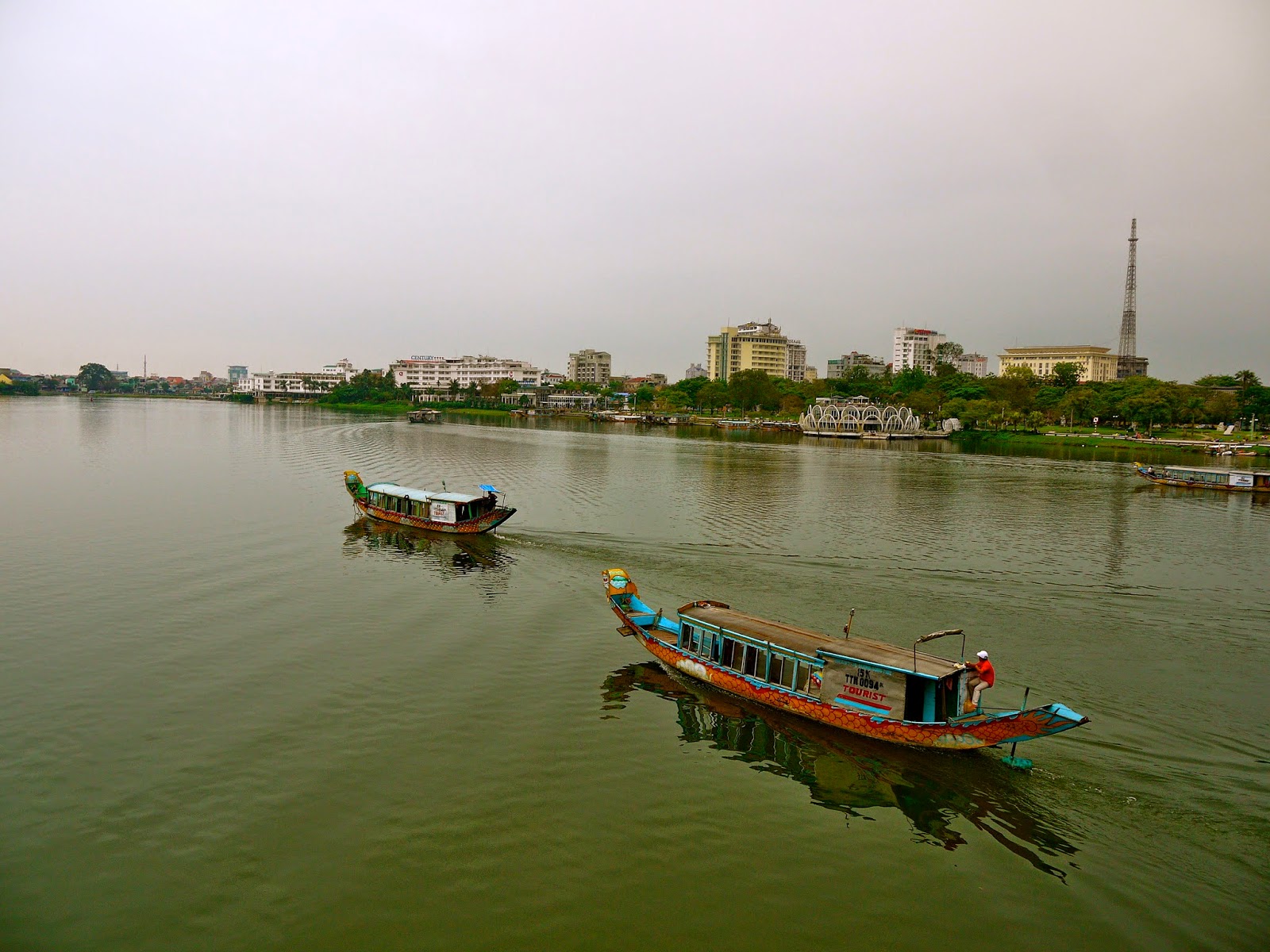
Perfume River
(it did not smell of perfume...)

Approaching the Citadel

Ngan Gate


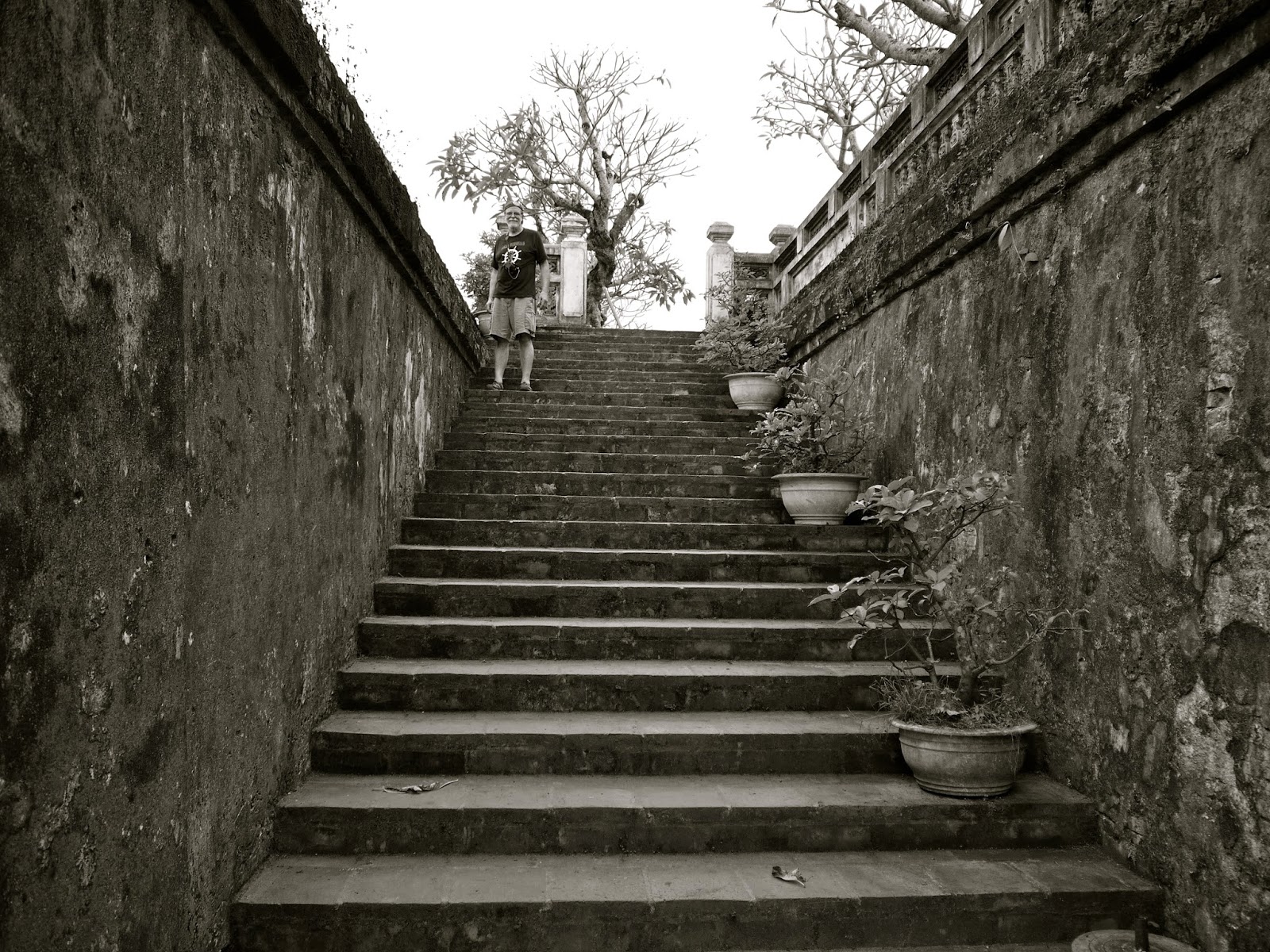
The Citadel is surrounded by a 2m-thick brick wall and houses the Imperial City, historic halls and palaces, and many Hue residents.  We decided not to enter the Imperial Enclosure, but instead strolled along the perimeter of the 2.5km-long walls of the citadel-within-a-citadel.  

Imperial Enclosure walls and moat

Bridge

Citadel wall

Imperial Enclosure gate


Along the way, we saw the 37m-high Flag Tower, Vietnam’s tallest.  We stopped to snap shots of the Nine Holy Cannons, representing the four seasons and the five elements.  


Flag Tower

Four Seasons Cannons

In an attempt to conserve our energy for the upcoming action-packed days of travel, we took our sweet time circumambulating the Imperial Enclosure.  We stopped frequently for pictures and wished desperately for a coffee shop, to no avail!

Crack kills

More moat

Dad climbs up the wall hoping for coffee

Lily pads


After crossing back over the Perfume River, we beelined over to the bar district and settled in for a few refreshing local brews.

Boats on the Perfume River

When in Hue....


That night, after dinner, we went to bed early, to dream of sugarplum fairies and fully-automatic motorbikes.  An epic journey awaited us in the morning!

Sunday, April 20, 2014

Nha Trang Love


Let this be a warning: Happy Hour, The Newlywed Game, and Vietjet Airlines do not mix!

We spent the afternoon of Valentine’s Day drinking discount cocktails and quizzing Lou and Trina on their knowledge of each other’s vital information, like “If she were dying, what would her last meal request be?” and “If she could be a shoe, what shoe would she be?”  While this caused many laughs (and a few tense and awkward moments), it also caused us to lose track of time.  As we politely encouraged the cab driver to hurry the F up, worries mounted that we might miss our flight to Nha Trang for a weekend away with friends.

Me, Lou, Trina, and Lisa taking a break from yelling at the traffic
to pose for this taxi selfie
Missing our flight is the OPPOSITE of what happened when we arrived at the airport.  We DID miss the ridiculously strict window of opportunity to CHECK IN for our fight.  But we did not miss the actual flight.  We tried everything to be allowed to check in: begging, pleading, reasoning, lying, threatening, backing away slowly as security began to surround us.  Nothing worked.  We could not check in for the flight.

Not to be shut out of the fun and sun promised in the brochure, we anted up and swiped our credit cards for a new flight on a different airline, leaving just an hour later.  I could write an entire blog post about the events that followed that evening at the airport, but let me sum it up quickly: Vietjet is a ridiculous airline and we ended up arriving in Nha Trang about 3 hours BEFORE our friends who didn’t miss the check-in with Vietjet.

The next morning, Lisa and I woke up bright and early and made a plan for the day.  After strolling along the beautiful beach, we convinced Hannah and Heather to join us for a cycling tour of rural Nha Trang.  

Nha Trang Beach


Using my trusty TripAdvisor app, I found Vietnam Active and set up a private tour with our guide Thanh.  We chose the City and Countryside Bike Tour because it was advertised as “Easy”.  No sense exerting ourselves while on vacation.

Heather, Lisa, Hannah, and me cycling around Nha Trang


The tour took us first to Po Nagar Pagoda, which dates back to the 7th century Cham population.  Thanh told us the temple was built in honor of a woman who appeared in town as a child during difficult times.  She was deemed lucky, as things began to improve after her arrival.  Legend has it she disappeared into thin air one day, and the townspeople built the temple to honor all she had done.

Po Nagar Pagoda

Po Nagar

Nha Trang from Po Nagar

Po Nagar


Next we continued cycling along the coast toward our first rest stop at Hon Chong, known as Husband Rock. Apparently some lady waited so long for her husband to return from sea that she turned to stone.  Ah, love.

Careful there

Standing on Husband Rock

Nha Trang Bay / South China Sea

Hon Chong


Back on the road, we took a turn down a gravel path and meandered through the countryside and a sweet little village.  Sparse motor traffic and beautiful landscapes made the cycling very pleasant.

Nha Trang Countryside

River

Lisa cycles across the rickety bridge

Nha Trang


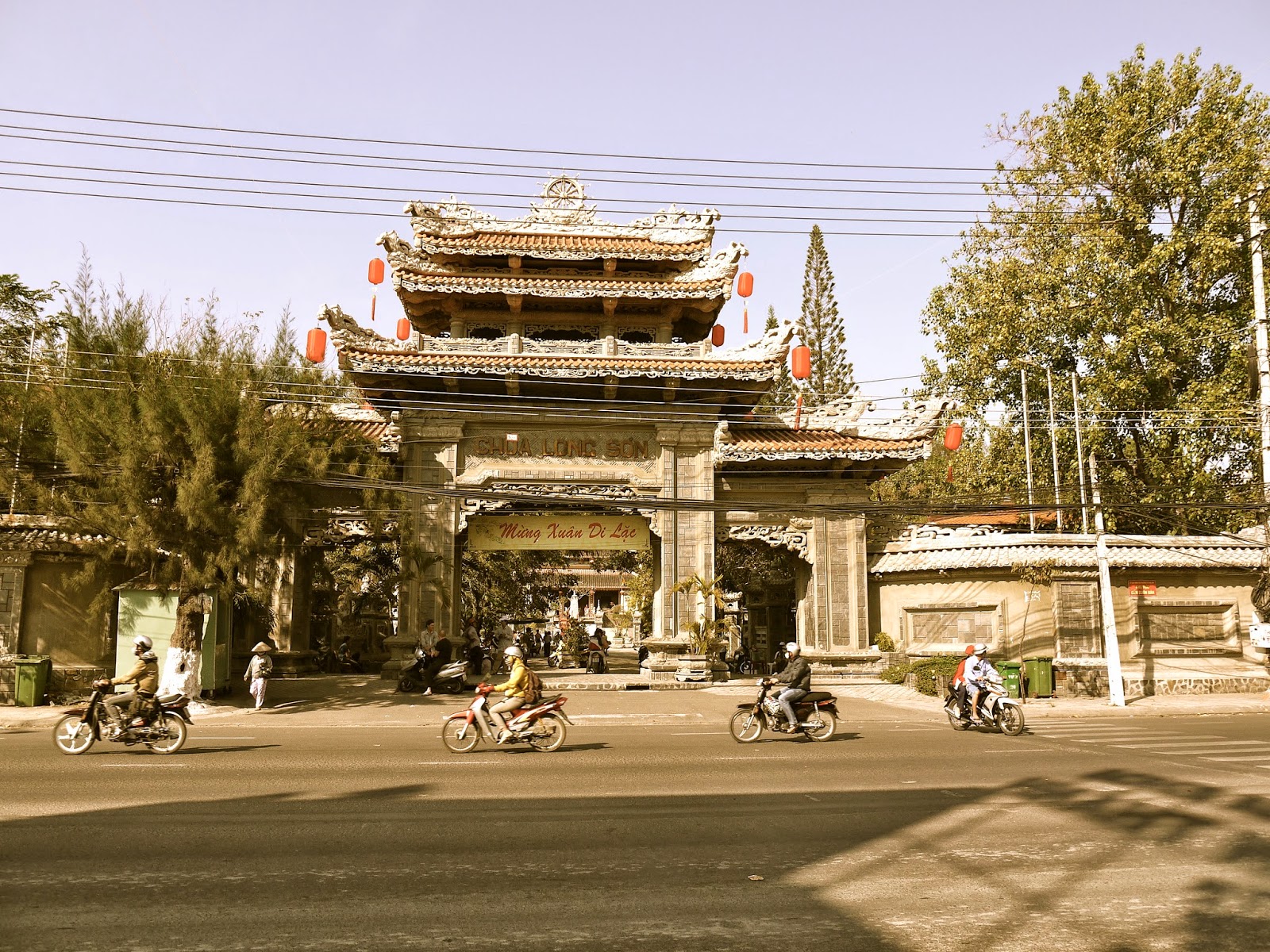
Next stop on the tour was Long Son Pagoda.  As the temperature rose steeply in the mid-afternoon sun, we wandered around the temple complex and stumbled upon a monk striking a bell.  Thanh told us that if you sit inside the bell and make a wish while the monk strikes the bell and chants, your wish will come true.  Of course we could not pass up this opportunity.

Long Son Pagoda

Monk


I don’t remember what my wish was (probably not a good sign), but sitting inside the bell as the monk chanted and rang the gong, I looked up and saw a collection of wishes written in markers on the inner surface of the bell.  It was such a strange experience, but quite lovely!

Making a wish


To commemorate our time together, Thanh bought us each some calligraphy from one of the monks outside the big Buddha statue.  

Can you tell what he's writing?


Our final destination was the Nha Trang Cathedral, a French church built in the 1930s.  To be honest, by this point we were pretty tired and hungry, so I can’t remember much about the history.  But here’s a few pictures to prove I was really there.

Nha Trang Cathedral

Nha Trang Cathedral


That night, we showered up and set out for a Nha Trang pub crawl, organized by yours truly.  Basically I consulted TripAdvisor for the most popular bars and plotted their location on the free map from our hotel.  Then I spent the entire night making sure we did not steer off course, which became more difficult with each sickeningly sweet bucket of booze.

Official Pub Crawl Route


The next morning, we relaxed on the beach for a while before packing our bags and riding an electric golf cart (??!!) to the mud baths.  


Nha Trang Beach


How do I always manage to get the front seat?


Now, these mud baths... Wow.  Nha Trang has several mud bath spas, but we went to the iResort, as recommended by, you guessed it, TripAdvisor.  I should be getting sponsored by those guys.  We started off in the crowded changing rooms, throwing elbows to find enough space to get near enough to our assigned locker to cram our bags inside.  After a wander around the immense spa, we squished and squashed ourselves into a mineral mud bath.  It was runnier than expected, but after a few minutes of uncertainty and skepticism, we embraced the cool muck and rolled around like .... well, I was going to say ‘pigs’ but we are way too stunning to be described in such a way!

Lara, Lisa, Sarah, me, Hannah
Wallowing :)


Had we planned slightly better, we could have taken full advantage of the many mineral pools and waterfalls around the spa.  You could easily spend the entire day there, hopping from pool to pool, soaking up the curative minerals through osmosis.  

Sadly, we had a plane to catch, and heck if we were gonna miss another flight!  The whole group met for an early dinner at Louisiane Brewhouse.  The cherry on top of our weekend of delights, the restaurant served delicious Witbier brewed on sight. 

Good beer, how I've missed you!


A somewhat-sketchy unmarked taxi ride back to the airport followed dinner.  Of course the return flight with Vietjet was delayed.  I won’t complain about it here because I want the weekend in Nha Trang to end on a positive note.  So I’ll just leave you with this creepy doll sold in the airport shop to sum up once again how I feel about That-Airline-That-Shall-Not-Be-Named.

Eek! The stuff of nightmares!

Tuesday, March 25, 2014

El Nido, Palawan


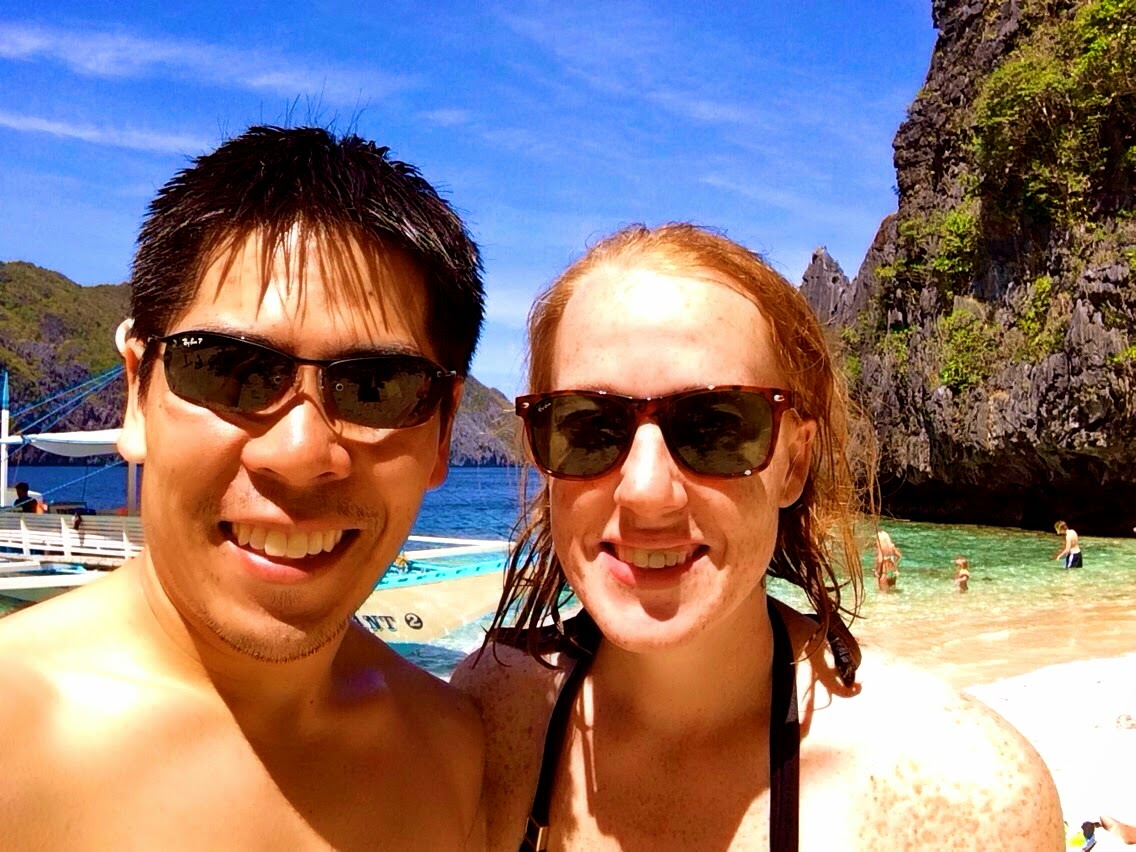
During the Tet holiday in January, I traveled with my friend Dave to the Philippines.  I’d been once before, but this trip was to El Nido, Palawan, known for its natural beauty and cluster of islands.

Inspired by this magnificence, and the current English unit at school about non-rhyming poetry, I’ve decided to tell the tales of my adventure in El Nido, Palawan, in acrostic form

So, here’s to you, El Nido!

E: Experience

When people ask me where is the most beautiful place I’ve been, it’s difficult to choose just one.  But I think if I really had to choose, I would say the Philippines, and feel confident in my answer.  Of course, there are plenty of places I haven’t been, and plenty of places in the Philippines, but the parts that I’ve seen...there is no comparison!

The people are friendly, the food is delicious, the views are beyond words.  It just feels good to be there.

So if I can give you a bit of unsolicited advice: Go EXPERIENCE the Philippines!!

Our first glimpse of Palawan from the plane


L: Landscapes

I mentioned the views are beyond words, and really, it’s true.  I’ll let the pictures speak for themselves.  The first beach we visited was in El Nido town.  Not a great beach for sunbathing, but clean nonetheless.  The whole strip is lined with hotels and restaurants, but it was surprisingly quiet when we were there.

The bay at El Nido

El Nido


One afternoon, we rented a motorbike and drove out through the country to a beach called Nacpan.  About halfway there, the paved road ran out, and we rode the rest of the way down gravel roads full of potholes and across tiny bridges made of rotting logs.  But we got to see this!!

Rural Palawan

Country road, DON'T take me home!
Nacpan Beach
Paradise??

After eating some possibly dodgy seafood, Dave and I both got food poisoning.  It was a bonding experience.  There is no way to un-hear someone puking their guts out through the thin bathroom wall.

To recover from our nastiness, we spent an afternoon lounging on a nearby beach called Las Cabanas.  I mostly laid in the shade, sipping a coconut to replenish my electrolytes.  But if you’re going to “waste” a day in paradise, this ain’t a bad way to do it.

Las Cabanas Beach


N: Natural

Our hotel, Island Front Cottages, made it very clear when we booked that electricity is a privilege, not a right, on Palawan. The power only operated for certain hours of the day.  Most of the businesses ran generators during the outage hours, though.  We had to time our showers to allow for the hot water heater, or pay an icy price.

Our hotel beach at low tide

No power lines


On our last day on the island, it rained.  It rained all day.  All day.  And because most people had traveled to El Nido to go scuba diving, island hopping, and sunbathing, the entire tourist population was trapped in the restaurants and bars along the one little road through town.  We, of course, found friends in a bar to spend the time with, drinking and playing cards.  Ahhh, the simple life.

El Nido town

If I lived here, I'd see this every day...


I: Island hopping

El Nido is part of the Bacuit Archipelago, which consists of 45 islands scattered around the South China Sea.  This makes for an excellent day of island hopping on a banca boat.  Dave an I packed our sunscreen and booked ourselves some fun in the sun with Art Cafe’s famous Tour C.  

The tour took us to such mystical places as Hidden Beach, Secret Beach, Matinloc Shrine, and Helicopter Island.  The scenery cannot be rivaled, and again I think I should just let the pictures speak for themselves.

Hidden Beach

Dave swims through the tunnel to reach Secret Beach

Matinloc Shrine

Matinloc Island
Look at that clear water!!

Lunch break

Island hoppers


On the tour, we got to snorkel at several locations, and the water was so clear and full of life, it put an other snorkeling I’ve done to shame.  I even saw an octopus!!

OoooOooo, a collage!


D: Diving

When I learned to SCUBA dive in Thailand back in October, I thought diving was the most amazing thing ever invented.   Little did I know it could get BETTER! Because El Nido is so well-preserved, the diving is beautiful.  We were lucky and had good weather conditions for excellent visibility and plenty of sea life.  

I don’t have an underwater camera, and Dave’s isn’t safe to use at diving depths, so I don’t have any pictures of diving.  But let me just say this: we went on nine dives over the course of the week, and never once were we disappointed in what we saw.  I saw tons of clown fish in sea anemones, trumpet fish, giant clams, sea cucumbers, and countless jellyfish.  I swam through a school of yellow snapper.  And I watched a sea turtle eating coral.  I mean, come on!!

I'm not as terrified as I look


O: OMG when can I go back??

The one bad thing about a spectacular vacation is that it only makes you want to go back.  I don’t see how the pristine beaches and sensational diving could get old any time soon.  But maybe I should branch out and see other places?  Get another stamp in the ol’ passport?  Try some new cuisine?  

Lucky for me, my job has good holidays.  Sipadan, anyone?

Corong Corong sunset

More this.

Sunday, March 2, 2014

Wow, You're So Brave: A Guide to Packing Your Bags and Moving Abroad

Today’s article is written for the Reach To Teach Teach Abroad Blog Carnival, a monthly series that focuses on providing helpful tips and advice to ESL teachers around the globe.  The host for this month is Maggie Attoe; here you can find other similar articles. I'll be posting a new ESL-related article on my blog on the 5th of every month. Check back for more articles, and if you'd like to contribute to next month's Blog Carnival, please contact Dean at dean@reachtoteachrecruiting.com, and he will let you know how you can start participating! 


Ever since I decided to leave my teaching job at home and move overseas to teach English, before I even knew quite what I was doing myself, people have been asking me questions, seeking my advice, picking my brain for bits of information on this crazy commitment.  Of course I’m happy to share what I know, and if you know me at all, you understand how much it means to me to feel like I’m imparting wisdom on others.  Drawing great pleasure from acting as if I know everything is one of the main reasons I went into teaching.

Recently, one of my friend’s coworker’s daughters (think it through) sent me an email filled with questions about my experiences teaching abroad.  Her questions are similar to the wonders and worries I had before embarking on my own big move.  I’ll do my best here to answer her questions, along with a few other tidbits of golden insight.


  • What made you choose Vietnam? 


I get this one all the time.  Same when I lived in Taiwan.  Even the locals ask me, “Why did you choose to live here?”  Unfortunately, I don’t have a good answer to this one.  “It just sounded cool,” doesn’t seem like a sensible reason to move to the other side of the globe, but it’s the most honest answer I can come up with.  I didn’t know anyone in Taiwan or Vietnam before showing up at the airport.  I guess deep down I chose Taiwan because it was more “off the beaten path” than China, Japan, or South Korea.  Maybe I thought it would make my experience more interesting.  Doesn’t really matter in the end though because Taiwan is amazing and you should definitely move there.  And as for Vietnam, I knew I wanted to live here after hearing other people tell me about their travel experiences in the country.  I’ve been living here for nearly a year, and you should definitely move here, too.

  • Have you been in charge of your own lesson plans, or were you originally assigned more of a teaching assistant role? What age group are you working with?


Questions about the day-to-day job are common.  I had them before moving as well.  However, since I’d already been a teacher for four years, I was less nervous about this aspect than someone fresh out of college or who has never taught before might be.  I can only really speak about my own teaching jobs, but of course there are many paths you can follow teaching overseas.  

I worked for Shane English School in Taiwan, a company I was placed with through the recruiting agency Reach To Teach. As the first and only English teacher at my little school in Wugu, I was able to run things the way I wanted.  I was responsible for all my own lesson plans and developing materials and resources.  I had a teaching assistant in most lessons, who corrected the homework and worked with the students after class to ensure they understood the grammatical points in the lesson.  Because it was a language school, I worked with a wide range of students, from age 5 or 6 to adult.

Here in Vietnam, I teach at British International School, which is a well-respected primary school.  Again I am responsible for lesson plans and developing classroom materials.  We work with several teaching assistants as well.  The primary school is for children from age 3-12, and there is a secondary school for older students as well.  I teach kids aged 4-6 this year


  • What are the differences in teaching in public and private schools?


I haven’t taught in public schools overseas, so I’ll be drawing from my friends’ experiences here.  At the private schools I have taught in, schools where the parents pay a hefty tuition for their children to attend, I have noticed that money matters.  At times, it can feel as though the school is a business first, and a school second.  However, I think if you as the teacher keep the children and learning as a priority, that is what makes the difference.  There is nothing you can really do about major corporate policies, but there is always something you can do to help students learn.

I have some friends who teach at public schools here in Vietnam, and their experience at work each day is quite different than mine.  While I typically work with small groups of students to focus specifically on their English language needs, the teachers in the public schools stand in front of classes of up to 40 or more students with only a blackboard and a piece of chalk.  Just like teaching in public schools in America, there is little you can do about changing the system, and reaching each child in a group that large is not easy.  But again, teaching is what you make of it, and knowing that you’ve done your best to help your students attain their goals is what matters.

My advice would be to find out as much as you can about the schools you are considering.  Ask for contact information for current and/or former teachers to get the real scoop.  There are good and bad schools in any situation.  


  • Did you get your TESOL certificate before going overseas? Was it necessary with the program you went with and did it feel like a big help?


Because I was a teacher at home, I already had a teaching certificate and a Masters in Teaching.  When I went to Taiwan, I did not go for any additional certifications.  However, most schools in Taiwan require at least a Bachelor’s Degree and a TESOL/TEFL certification.  

When I came to Vietnam, I went through the CELTA course, which is well-recognized in many countries worldwide.  I did not necessarily need the CELTA to get a job here because I already had a teaching license, but I did find the course useful.  Teaching English as a second language does require a specific set of skills.  Of course, a good teacher can learn to teach most anything, but the CELTA course provided me with a solid batch of skills to plan strong language lessons.  Plus I learned a load of nerdy things about grammar.


  • Were accommodations more or less what you thought they would be? Any advice on big city versus small town? 


This question I feel I can answer fully, as I’ve lived in both a small town and a big city.  In Taiwan, I lived a small suburb of Taipei called Wugu, where I was pretty much the only foreigner.  My rent was ridiculously cheap (less than $200 per month including utilities) in my shared apartment with two amazing Taiwanese girls.  My apartment was lovely compared to many of my friends who lived in tiny musty rooms in Taipei.  Life was sweet there in Wugu, but I did spend a lot of time by myself.  This was a good growing experience for me, learning to be with just me.  However, I did get lonely and felt like I had to live it up every weekend when I went in to the city to see my other foreign friends.  I wouldn’t trade my time in Wugu for anything, but I would think very carefully before moving to such an isolated location.  I feel silly even describing Wugu as “isolated” because I was constantly surrounded by hundreds of thousands of people, but that’s the best description I can give.

Here in Vietnam, I live smack-dab in the center of Ho Chi Minh City, and I share a house with five other foreigners.  Rent is still cheap (about $300 including utilities), and we have a lot of space.  I have no lack of native-English-speaker interaction, due to my living situation as much as my working environment.  Teaching at the British school, where everything is conducted in English, means I have very little opportunity to tune out and hide inside a foreign-language bubble.  This leads nicely into the final question.


  • Do you feel like it's possible to pick up some of the native language even if you don't know much going into it?


The short answer is ‘yes’.  HOWEVER, I may have chosen the two most difficult languages for an English speaker to learn.  Before I moved to Taiwan, I started to learn Mandarin Chinese online, like a good little student.  As soon as I arrived in Taiwan, I stopped that immediately.  The accent and character system were different from the way the online lessons were being taught.  Lucky for me, I lived and worked in ‘isolated’ Wugu, full of wonderfully friendly people who couldn’t speak a lick of English but wanted to talk to me anyways.  Interacting daily with my Noodle Lady, the workers at 7-11, and the little old man outside the camera shop forced me to learn and use Chinese at least at a basic survival level.  I also took some free lessons through the Shane company, and my Taiwanese friends and coworkers were always willing to teach me useful words and phrases.  By the time I left Taiwan, after 15 months, I was able to get by in necessary situations like restaurants, shops, train stations, etc.

When I moved to Vietnam, I thought, “Oh super! They use the Roman alphabet over there!  Learning Vietnamese will be waaaaay easier than Mandarin.”

Wrong.

Vietnamese is the worst.  That Roman alphabet is just a false promise.  The letters don’t make the same sounds, and there are more tones than Chinese!  However, because I live in Saigon, learning the language isn’t really necessary.  This is a blessing and a curse.  The good thing is, I can almost always be guaranteed that someone nearby will speak English and be able to translate and help me get anything I need.  The bad thing is, I’m not learning the language!  I want to be able to chat with my Coconut Lady, the vendors at the street food stands, and the workers at the post office.  I have a private tutor now, but honestly I don’t have (or use) many opportunities to practice Vietnamese.  That must sound like a load of bull, seeing as I LIVE IN VIETNAM.  But really.  I work with foreigners.  I live with foreigners.  People in shops speak English.  And most of all, when I try to speak Vietnamese, it’s really bad and no one understands me.


  • My extra two cents.


If you’re thinking of teaching abroad, do it.  You will not regret it.  When my date to move overseas started approaching fast, I began to second-guess myself.  I kept worrying about all the little details that I hadn’t figured out yet.  There were so many uncertainties and unknown factors.  I’m not the type of person who particularly gets a kick out of that sort of thing.  I like a plan.  

The thing that got me through those worries and kept me from unpacking my bags and canceling my flight was reminding myself that I was not the first person to embark on this kind of adventure.  Many people younger and dumber than me had up and moved abroad, survived to tell about it, and even enjoyed it!  If you’re questioning your decision, just remember, you can always buy a plane ticket back home.